St Aidan
Aidan was an Irish monk at the monastery on the Island of Iona in Scotland.
The Roman Empire had spread Christianity into Britain, but due to the Anglo-Saxon invasion of Britain, paganism was now the dominant religion. In 634, Oswald regained the kingship of Northumbria and was determined to bring Christianity to the mainly pagan population. He requested missionaries from the monastery at Iona who sent a bishop called Cormán. He met with no success and soon returned to Iona, reporting that the Northumbrians were too stubborn to be converted. Aidan criticised Cormán’s methods and was sent as a replacement in 635.
Aidan chose Lindisfarne, an island like Iona and close to the royal fortress of Bamburgh, as the seat of his diocese. An inspired missionary, Aidan would walk from one village to another, politely conversing with the people he saw and slowly interesting them in Christianity. According to legend, the king gave Aidan a horse so that he wouldn’t have to walk, but Aidan gave the horse to a beggar. By patiently talking to the people on their own level, Aidan and his monks slowly brought Christianity to the Northumbrian communities.
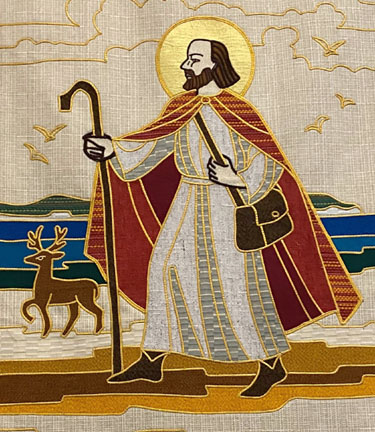
In 651 a pagan army, led by Penda, attacked Bamburgh and attempted to set its walls ablaze. According to legend, Aidan prayed for the city, after which the winds turned and blew the smoke and fire toward the enemy, repulsing them; hence his patronage for fire fighters. Aidan became ill in 651 while at Bamburgh castle and died on 31 August leaning against the buttress of a church on a royal estate near Bamburgh.
The monastery he founded grew and helped found churches and other monasteries throughout the area.
It also became a centre of learning and a storehouse of scholarly knowledge.
The Venerable Bede would later write Aidan’s biography and describe the miracles attributed to him.

St George
Saint George is popularly identified with England and English ideals of honour, bravery and gallantry, but actually he wasn’t English at all. Very little is known about the man who became St George. He is believed to have been born in Cappadocia (now Eastern Turkey) in the year 270. At the age of seventeen he joined the Roman army and soon became renowned for his bravery. He served under a pagan Emperor but never forgot his Christian faith.
The Emperor Diocletian gave him many important missions. He heard the Emperor was putting all Christians to death and so he returned to Rome to help his brother Christians. He pleaded with the Emperor to spare their lives. Diocletian did all he could to persuade Saint George to give up his faith, but he refused and was finally beheaded on 23 April, 303. It is said that the shield or flag of Saint George, with its red cross on a white background, represents his blood running across the white paving stones of the square where he was beheaded.
 St Aidan's